

The Channel Islands are a relatively little-known yet surprisingly diverse destination between France and England. Each island has its own character, from Jersey’s sweeping beaches to Sark’s quiet, car-free lanes. During my trip, I discovered a unique blend of nature, history and simplicity. A place where peace and space still come naturally.
The islands’ location gives them a remarkably mild microclimate, with relatively warm winters and cool summers. Their history, meanwhile, has been shaped by two powerful neighbours, France and England, both of which have left their mark on these small islands. Today, however, the Channel Islands are self-governing Crown Dependencies.
There are five main inhabited islands, with Jersey and Guernsey being the best known. But it was Sark, the third-largest, that intrigued me most. Its defining feature? There are no cars.
Sark
My adventure begins on Guernsey, where I board the ferry to Sark. As we sail past a collection of tiny, seemingly deserted islands, I find myself imagining dolphins leaping alongside the boat. They are regular visitors here, but unfortunately none show up today. Neither do the adorable puffins. Still, the crossing is beautiful.
We arrive at Sark’s picturesque harbour, where a friendly local helps us step ashore from the rocking boat. From the harbour, it’s a short walk to a small café where two tractors are waiting, each with a few seats attached to the back. There are two options: walk uphill or pay two pounds for a tractor ride to the main street. The decision is easy. There is something wonderfully absurd about being transported around an island by tractor, so I happily hand over the money.
At the top, I feel as if I have stepped into another world. The warm evening sun glimmers across a green landscape dotted with charming cottages. Families wait for passengers arriving from the ferry, not in cars, but on foot or by bicycle. Everywhere I look, there are smiling faces and an overwhelming sense of calm. I strike up a conversation with a woman who has just collected her two children from the ferry. The first thing I notice is that her bicycle is sitting there unlocked.
“We never lock our bikes here. We don’t even lock our houses,” she tells me with a smile, as if I have just asked the most ridiculous question imaginable. The thought makes me both happy and slightly melancholic. Happy that places like this still exist, but sad because such a way of life feels almost utopian in Antwerp, where I live. After a short walk through the main street, I arrive at my Airbnb, where I am warmly welcomed by a retired lady who rents out part of her home to earn a little extra income.

Sarkhenge
The next morning, my host hands me a walking map and I set off to explore the island. I follow the same direction as the sun, hoping to keep the best light on the landscape throughout the day. My first stop is Sarkhenge. No, that isn’t a typo. It is a miniature version of the much more famous Stonehenge. The stones here barely reach knee height, so they are hardly impressive in terms of scale. But they have not been placed here without reason. The view over the sea is spectacular, and the morning light filtering between the stones creates an almost spiritual atmosphere. A QR code next to the monument feels like a slightly misplaced gimmick of the modern world. The last thing I want to do here is reach for my phone. This is a place that asks you to switch off. After a while, I continue through the meadows, where two beautiful horses are grazing. With no cars on Sark, horses are still used to pull the island’s carriages.

As I descend towards the harbour, where my adventure on Sark began, I realise that getting lost here is almost impossible. The sea provides a natural boundary and an ever-present sense of direction.
Around midday, I return to the main street. Calling it a “main street” may be somewhat generous for a place without traffic and with only around 600 inhabitants, but there are a few shops and restaurants. I settle onto a terrace and order a drink. Watching village life unfold around me, I begin to appreciate the island’s slow rhythm. Everyone seems to know everyone, and people greet each other as they pass. Before long, I find myself recognising faces too.
Dark Sky Community
In the afternoon, I explore the other side of the island, heading towards La Coupée, a natural bridge connecting two parts of Sark. The narrow path winds gracefully across the strip of land, with the sea on either side. It is undoubtedly one of the island’s most photogenic spots. I decide to wait for a few walkers to appear in my photographs, but to my surprise you can genuinely be alone here. The walkers never arrive. After half an hour, I move on towards the far end of Sark in search of the Venus Pool, a natural swimming spot that only appears at low tide. Internet access is expensive here so I cannot check its exact location. But I don't really mind. Every corner of Sark looks like a postcard, so I simply follow my instincts.
Eventually, I reach the Pilcher Monument, built in memory of a London businessman who died at sea here. A set of steps beside the monument leads down to Havre Gosselin, a tiny harbour where several sailing boats lie at anchor. As the sun slowly disappears, I watch the sailors raise a toast to life. I find a rock, sit down and watch the sunset disappear behind neighbouring Brecqhou.

But the magic doesn’t end there. Later that evening, I end up at the Mermaid Tavern where I join the locals for a rather underwhelming pint. As darkness falls, I notice something remarkable: there is no street lighting. In 2011, Sark became the world’s first Dark Sky Community. Walking back to my accommodation later that night, I understand why. Above me is one of the most spectacular star-filled skies I have ever seen.
Car-free, care-free
The next morning, I leave my accommodation and head back to the ferry to Guernsey. The sea is rough, and we are lucky that the ferry is running at all. Crossings are regularly cancelled because of bad weather, which means a stay on Sark can easily be extended against your will. To be honest, I wouldn't have minded. Rarely have I experienced such a profound sense of peace as I did on this island. Sark is, without a doubt, a unique place. When I arrive back in Guernsey, I immediately have to start watching out for traffic again. Within minutes, I already miss Sark. The words of one of the islanders come back to me: “Car-free, care-free.” And who could argue with that?
On Guernsey, I set off in search of my next Airbnb. This time, I am staying with a former financial broker, as he describes himself. He has left the banking world behind and now runs several guest rooms. His appearance, oversized pink shirts and chinos so long they trail across the floor, initially makes me slightly suspicious. But he turns out to be an incredibly friendly and welcoming host. That evening, I explore St Peter Port, Guernsey’s largest town. There is no shortage of restaurants here, making it the perfect place to end the day in style before continuing my exploration of the Channel Islands.
Stars in the water
I have been told that the south of Guernsey is famous for its dramatic cliffs, while the northern part of the island is much flatter. So I begin my day in the south, at Bluebell Woods. The name alone sounds magical. The English really do have a talent for coming up with atmospheric place names. Despite the rain I feel completely at home here. The damp air and lush vegetation give the forest an almost tropical atmosphere. From there, I follow the Ozanne Steps down towards the water for a refreshing swim.

After my dip, I continue towards Fermain Bay, where I warm up with a coffee at the Beach Café. Once I have thawed out, I follow the coastal path towards Moulin Huet Bay, perhaps one of the most beautiful bays on the island. A local I meet on the beach tells me it is her favourite place. Then she asks whether I have already seen the mysterious lights in the water. I have absolutely no idea what she is talking about. Intrigued, I agree to return that evening to see the phenomenon for myself.
In the meantime, I cross the island to Vazon Bay on the west coast. The Channel Islands are also known for their surfing, so I am hoping for decent conditions. Unfortunately, the surf instructor has bad news: the waves are much better in autumn. As someone who gets cold easily, I politely decline and continue north.
Here, the landscape is dotted with reminders of the German occupation, a dark chapter that is still very much part of the islands’ history. The Channel Islands were the only part of the British Isles occupied by Nazi Germany during the Second World War. It is an important part of Guernsey’s story, but today I choose to focus on the island’s natural beauty rather than its darker past.
That evening, at exactly 10pm, I return to Fermain Bay for the promised spectacle. Despite the cold water, we dive in. With every stroke, tiny points of light seem to appear around us, turning the dark water into a moving star field. For a moment, it feels as though I have just swum straight into a Disney movie.
St Ouen’s Bay
The next morning, I board the ferry to Jersey, the largest of the Channel Islands. The weather is cold and, after several days of exploring, I reluctantly say goodbye to Guernsey. It is already late when I arrive in the busy port of St Helier, which feels like a miniature version of London. Fortunately, my accommodation is further away, in the quieter coastal village of Saint Aubin, where I end the evening with a local Greek meal.
The next morning, I set off from Saint Aubin to explore Jersey, following the coastline clockwise. My first stop is St Brelade’s Bay, where the parish church and its surrounding graveyard immediately catch my attention. The graves have an uninterrupted view over the beautiful bay, creating a setting that feels both peaceful and almost poetic.


From there, I continue to La Corbière Lighthouse. There is one important disclaimer: the lighthouse can only be reached at low tide. Timing is everything. Arrive too late and you risk getting stranded on the tiny island. Further along the west coast lies St Ouen’s Bay, one enormous sweep of white sand stretching as far as the eye can see. It must be one of the largest bays I have ever seen.

At the end of the bay, I stumble across Faulkner Fisheries, a restaurant serving local produce cooked over a barbecue, including Jersey scallops. The spectacular view comes free of charge. I continue north along the coast and eventually reach La Mare Wine Estate, surrounded by impressive country houses. A fitting reminder of the wealth found on these islands, which are also known for their favourable tax regime.
Mont Orgueil
For my final day, I have set my sights on Rozel Bay. A local I met the previous day told me it was the most beautiful bay on Jersey. When I arrive in the small harbour village, I can only agree. Once again, I find a little pocket of tranquillity, surrounded by a picturesque village that almost feels unreal. From Rozel Bay, I travel south towards Mont Orgueil, an imposing medieval castle perched high above the village of Gorey and its bay.
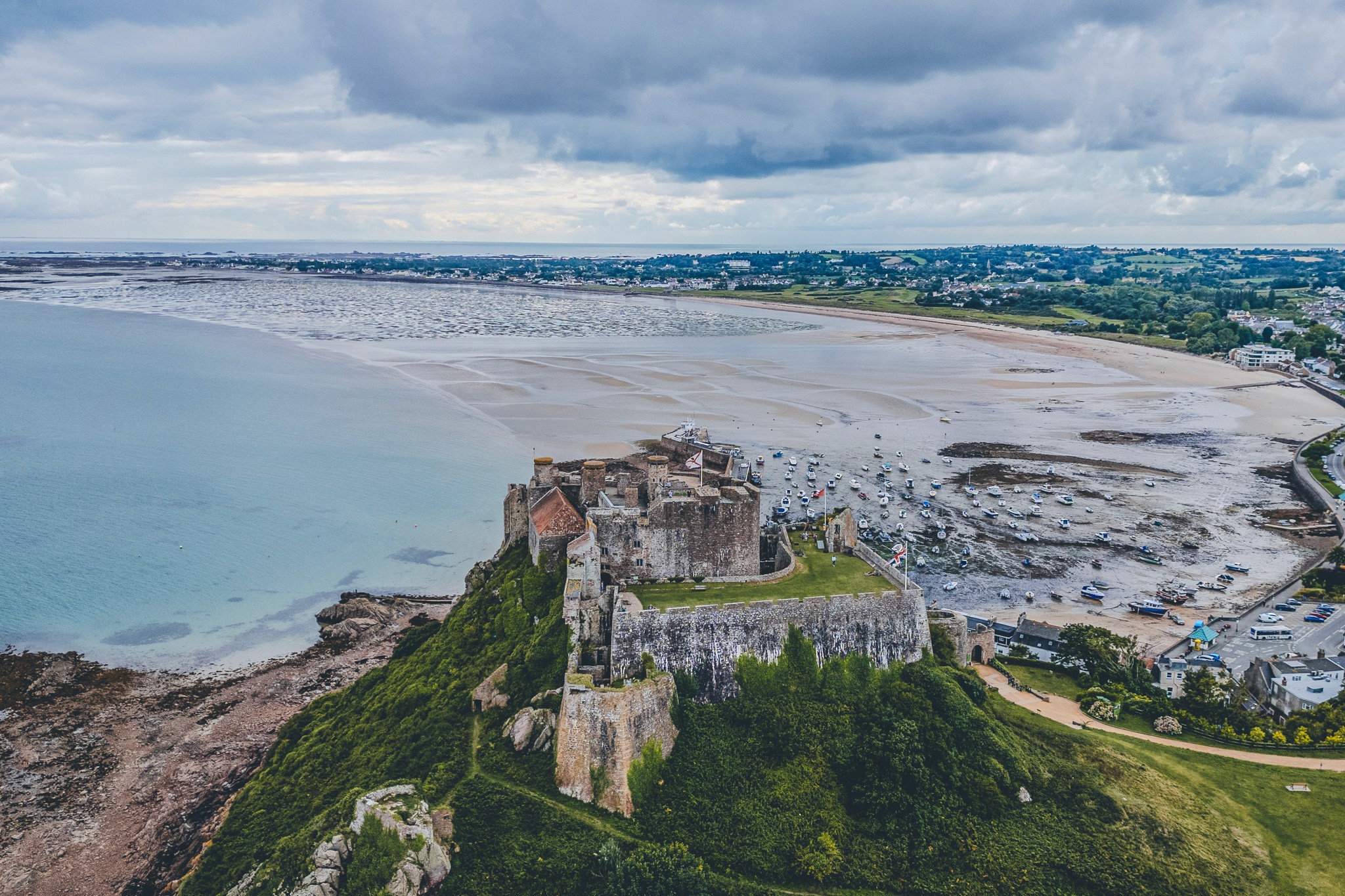
I decide to stop for lunch at a restaurant known for its seafood. I order a seafood platter that quite literally brings the ocean to my table. The colours and flavours are intense. It doesn’t get much fresher than this. It is the perfect ending to my trip. Not long afterwards, I board the ferry back to Saint-Malo and mainland Europe. As I cross the water, it feels as though I am leaving a dream behind. I look back one final time as Jersey slowly disappears over the horizon. For a moment, it almost feels unreal that such a place exists. Yet knowing that there are still quiet little worlds like this, far removed from the pace and noise of modern life — makes me happy. I have a feeling I’ll be back.

