

There is a particular kind of freedom that comes from driving for hours without seeing another human being. No traffic, no buildings, no noise, just an endless landscape unfolding around you. It is an experience that is increasingly difficult to find in Europe, let alone in Belgium. In Namibia, however, it is part of the everyday experience.
With a population of just over 2.5 million spread across more than 800,000 square kilometres, Namibia is one of the least densely populated countries in the world. To put that into perspective: the average Namibian has around 125 times more space to themselves than we do in Belgium. Those numbers make you realise just how vast the country is and how much preparation is required. Distances are enormous, petrol stations are few and far between, and you need to be largely self-sufficient. For us, that meant one thing: a 4x4 with a tent on the roof. We covered around 4,000 kilometres during our trip, crossing Namibia from the central regions towards the north, with nothing but the road, the landscape and the occasional wild animal for company.
Be prepared
You could, technically, drive all the way to Namibia from Europe. We even came across campers with European licence plates. But we opted for the easier solution: an evening flight via Frankfurt to Windhoek, the country's capital. Once there, the choice of vehicle is simple. Forget traditional motorhomes, they are simply not suited to the terrain. What you need is a properly equipped SUV. After comparing several rental companies and reading plenty of reviews, we chose Africa On Wheels. Their fleet consisted largely of converted Toyotas, equipped with everything you need for a trip like this: a heavy-duty front bumper, dual fuel tanks and, most importantly, a roof tent.
The tents are made by South African manufacturer Tentco and come in different sizes. Ours comfortably accommodated two people, while larger versions are available for families. The load area contained everything else we needed: chairs, a table, gas stove, fridge and cooking equipment. Two spare tyres came as standard and in Namibia, you should assume you will eventually need one of them. An air compressor connected to the car battery was also included, allowing us to adjust the tyre pressures when leaving the tarmac. We even rented a satellite phone for €150. We never actually needed it, as conventional mobile coverage was better than expected. Still, having it with us gave us the confidence to venture further onto remote 4x4 tracks.
Sixteen days of adventure
We had sixteen days to explore Namibia. Seeing the entire country in that time would be impossible, so we concentrated on the central and northern regions. If you want to see everything, you should allow at least a month. As an older man told us towards the end of our trip: you can see the country, but you also have to experience it. That turned out to be excellent advice. Namibia is not a country to rush through. Take your time, slow down and enjoy the sheer scale of the landscape.
We spend as little time as possible in Windhoek. After stocking up on supplies, we leave the last traffic lights behind and head towards the unknown. The adventure begins. Our first planned overnight stop is the Spreetshoogte Pass. Unfortunately, the campsite we found on Google Maps is closed for renovation, leaving us with only one option: wild camping. The rules surrounding wild camping in Namibia are somewhat vague. According to our rental company, it is generally allowed, except on private land and in places such as Sossusvlei and Etosha. But legality is only part of the equation. Namibia is still genuinely wild, and that means predators, aggressive baboons, snakes, spiders and scorpions are all part of the environment.

We make sure to find a suitable spot before sunset and quickly put up our roof tents. Within five minutes, everything is ready. As the sun disappears, the landscape changes colour around us. We cook our first dinner on the gas stove and crawl into the tent early. Unfortunately, we have made a classic beginner's mistake: camping on an exposed mountain top. The wind gets stronger throughout the night, and at around 4:30 am we have no choice but to fold the tents back up. Lesson learned. Still, the moonlight illuminating the endless plains almost makes up for the lack of sleep. And during our entire stay on the mountain, we don't encounter a single person. Try finding that kind of peace on the Stelvio Pass.
Desert, apple pie and Deadvlei
With small eyes, we head towards Solitaire. In the middle of the desert, a handful of ancient car wrecks mark this tiny settlement, which consists mainly of a petrol station and a café serving apple pie. It sounds bizarre, but the combination has become something of an internet sensation.

From Solitaire, we continue south through the Naukluft Mountain Zebra Park, where we see precisely zero zebras, towards the world-famous Sossusvlei. The park has strict opening hours: it opens at sunrise and closes at sunset. There is also an entrance fee per person rather than per vehicle. A campsite just beyond the entrance makes a convenient base for exploring the area later in the day. From there, it is still around an hour's drive to Deadvlei, so timing is important if you want to experience the area around sunset.
The sight of the black, dead trees standing against the orange dunes is every bit as spectacular as the photographs suggest. What surprises us most is that we are almost completely alone. We attempt to climb one of the dunes, but quickly realise that the combination of soft sand and steep slopes is more ambitious than expected. Back on the plain, we admire the trees once more. Their dark silhouettes contrast dramatically with the orange dunes, whose colour comes from oxidised minerals in the sand.
Where the desert meets the ocean
The following morning, we drive for five hours towards Walvis Bay. It is a long stretch, but the landscape changes constantly, making the journey anything but boring. Along the way, we cross the Tropic of Capricorn. It is almost 21 December, meaning the sun is approaching its highest point in the southern hemisphere. While Belgium is heading into the depths of winter, we have traded grey skies for the African summer.
Walvis Bay was once a South African enclave, largely because of its important harbour. Today, it is perhaps best known for its large flamingo colony. Thousands of flamingos feed on crustaceans in the shallow water, which gives their feathers their characteristic pink colour. Just outside Walvis Bay lies the Namib Desert, the oldest desert in the world and the landscape from which Namibia takes its name. Driving independently through some areas of the desert is prohibited, so we hire a guide. The experience is remarkable: the Atlantic Ocean appears to meet the desert almost literally at the foot of the dunes. With a little luck, you can also spot Cape fur seals and even whales.
The land of the Lion King
Less famous than Deadvlei, but perhaps even more magical, is Spitzkoppe. Rising dramatically from the surrounding plains, this isolated mountain formation has a distinctly cinematic quality. If you've ever watched The Lion King, you'll understand the comparison immediately. A large campsite surrounds the mountain, and we settle into campsite number five. Once again, we are completely alone. As the evening arrives, the view becomes breathtaking.

The following morning, we hike up one of the rock formations next to Spitzkoppe. The walk takes around three hours and rewards us with spectacular views from the top. Those looking for a greater challenge can climb Spitzkoppe itself, but that takes around six hours and is considerably more demanding. By midday, we're back in the car and heading towards Brandberg. The scale changes once again. Königstein rises to 2,573 metres, making it the highest mountain in Namibia. Seen from above, Brandberg forms an almost perfect circle, surrounded by nothing but vast plains and the White Lady campsite. Using offline maps and Google Earth, we try to find a route back towards the coast.
A detour worth taking
Back in the direction of the coast, we discover a route that hardly appears on the usual lists of things to see in Namibia: the Messum Crater. There is surprisingly little information about it online, and it rarely features on conventional itineraries. For us, it becomes one of the highlights of the entire trip. Not just the crater itself, but the five-hour journey from Brandberg to Cape Cross is extraordinary. We don't encounter a single other person along the way. In the middle of the crater stands a mountain offering a 360-degree view across the surrounding plains. We stop, turn the music up, open a beer and simply enjoy the moment. Moby is playing through the speakers, the landscape stretches endlessly in every direction, and there is absolutely nobody around. This is what happiness feels like. We would happily have opened the tents again and stayed for another night.
The Skeleton Coast
From Brandberg, we head towards the Skeleton Coast. The name sounds ominous and the landscape certainly lives up to it. The coast is famous for the bones that wash ashore and the ships that have met their end in these waters. We don't immediately find any of the famous shipwrecks, but the thick mist creates an eerie atmosphere all of its own.

We eventually have to turn inland towards Damaraland. The temperature rises quickly, and the landscape turns orange, with hints of green caused by the abundance of iron and copper in the ground. We spend two days crossing Damaraland towards the Angolan border. The name alone sounds like an adventure, and the region is home to the Damara people, one of Namibia's oldest communities. Somewhere along this long stretch, we find a campsite hidden inside a canyon, complete with running water. In an otherwise dry landscape, it feels like a green oasis.
Epupa Falls
The following day, we finally reach Epupa Falls. The waterfalls are an impressive sight, best appreciated from the hills above the river. Our campsite sits almost directly at the beginning of the falls, and from the restaurant terrace we can watch the water rushing through the landscape. The long journey north has been worth it. Very few travellers venture this far, and once again we are rewarded with an extraordinary sense of space and solitude. From Epupa, the Kunene River guides us towards Ruacana. We follow a challenging track running parallel to the river, which cuts a green ribbon through the otherwise dry landscape. For a moment, it feels as though we're following the Nile through Egypt. The further we travel, the more the landscape changes.

Etosha
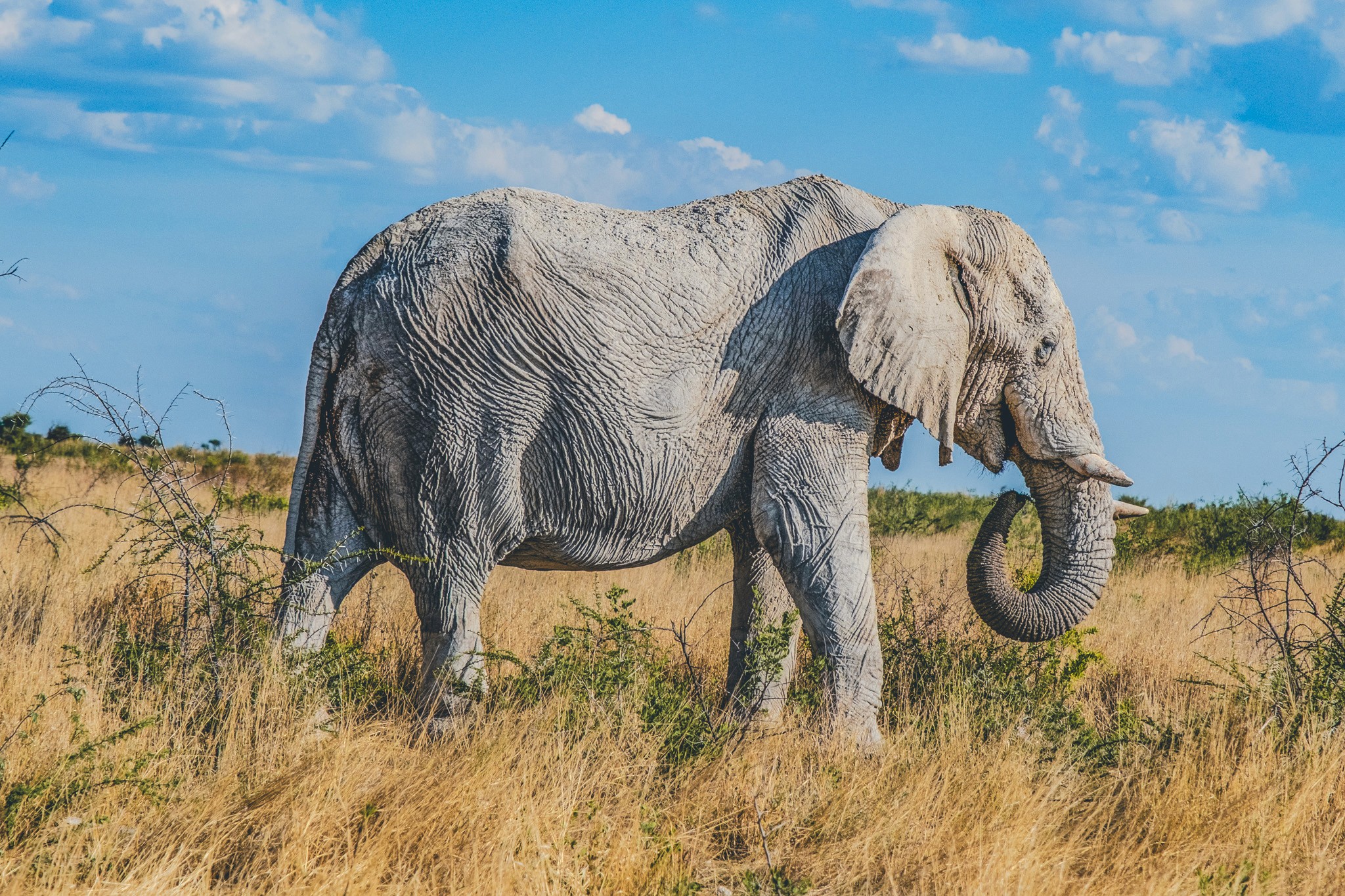
Eventually, we reach the first entrance to Etosha National Park. Etosha is one of Namibia's largest and best-known national parks and features high on the itinerary of most visitors. Unfortunately, that also means the feeling of being completely alone begins to disappear. The wildlife, however, is spectacular. Antelope, zebra, giraffes and even elephants are relatively easy to spot. The scenery is beautiful, although the campsites are considerably busier than the remote places we've stayed previously. Once inside the park, however, the crowds thin out and the wildlife takes centre stage. We even spot a cheetah, while several rare bird species catch our attention. A pair of binoculars is essential. The best advice is simple: get up early. Around midday, temperatures rise and many animals retreat into the shade. The evening is another excellent time for wildlife spotting, although you need to return to camp before the gates close at sunset.
The final view
From Etosha, we begin our journey back towards Windhoek. But there is one final stop: the Waterberg Plateau. This enormous rock formation covers around 405 square kilometres and creates an isolated ecosystem high above the surrounding plains. Endangered species have been relocated here in an effort to protect them from poaching. The climb to the top is relatively short, but the view is anything but modest. From up there, the landscape stretches towards the horizon in every direction. It is the perfect ending to a camping trip that has exceeded every expectation. Namibia is not a country you simply visit. You have to slow down, accept the distances and let the landscape dictate the rhythm of your journey. And perhaps most importantly, you have to leave some room for the unexpected. Because sometimes the best moments are found somewhere between two destinations on a forgotten track, in an empty crater, or on a mountain where the only company is the wind.

